


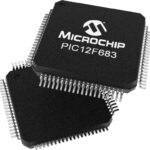
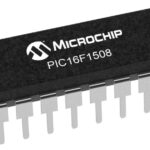
Microchip – PIC16F1503-I/SL
Debug Support
• External debug header (AC244051/AC244052) is needed for debug support
• Debug and Programming support is available via PICkit™ 3, and MPLAB® ICD 3
DOWNLOADS:
Product Features:
- Enhanced Mid-range Core with 49 Instruction, 16 Stack Levels
- Flash Program Memory with self read/write capability
- 128 B of Non-volatile Data Storage
- Internal 16MHz oscillator
- 4x Standalone PWM
- Complementary Waveform Generator (CWG)
- Numerically Controlled Oscillator (NCO)
- 2x Configurable Logic Cell (CLC)
- Integrated Temperature Indicator
- 8 Channel 10-bit ADC with Voltage Reference
- 5-bit Digital to Analog Converter (DAC)
- MI2C, SPI
- 25mA Source/Sink current I/O
- 2x 8-bit Timers (TMR0/TMR2)
- 1x 16-bit Timer (TMR1)
- Extended Watchdog Timer (WDT)
- Enhanced Power-On/Off-Reset
- Low-Power Brown-Out Reset (LPBOR)
- Programmable Brown-Out Reset (BOR)
- In Circuit Serial Programming (ICSP)
- In-Circuit Debug using a Debug Header
- Wide Operation Voltage Variant ‘F’ (2.3V – 5.5V)
- eXtreme Low Power (XLP) ‘LF’ Variant (1.8V – 3.6V)
Related products


Microchip – PIC16F1936-I/SO SOIC
Alternate Products: PIC16F19155
This versatile 28-pin MCU is also a member of Microchip's extreme low power microcontroller family featuring nanoWatt XLP technology. Debug Support • Integrated debug support on Device. No Debug Header is required • An optional external Debug Header, AC244035 or AC244036, is also available for Debugging support • Debug and Programming support is available via PICkit™ 3, and MPLAB® ® ICD 3 •
DOWNLOADS:


Microchip – PIC16F73-I/SO SOIC
This powerful (200 nanosecond instruction execution) yet easy-to-program (only 35 single word instructions) CMOS FLASH-based 8-bit microcontroller packs Microchip's powerful PIC® architecture into 28-pin package and is upwards compatible with the PIC16C5X, PIC12CXXX and PIC16C7X devices. The PIC16F73 features 5 channels of 8-bit Analog-to-Digital (A/D) converter with 2 additional timers, 2 capture/compare/PWM functions and the synchronous serial port can be configured as either 3-wire Serial Peripheral Interface (SPI™) or the 2-wire Inter-Integrated Circuit (I²C™) bus and a Universal Asynchronous Receiver Transmitter (USART). All of these features make it ideal for more advanced level A/D applications in automotive, industrial, appliances and consumer applications.
DOWNLOADS: