


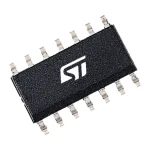
LM319ST SOIC
These products are precision high-speed dual comparators designed to operate over a wide range of supply voltages down to a single 5 V logic supply and ground. They feature low input currents and high gains.
The open collector of the output stage makes them compatible with transistor-transistor logic (TTL) as well as capable of driving lamps and relays at currents up to 25 mA.
Although designed primarily for applications requiring operation from digital logic supplies, these comparators are fully specified for power supplies up to ±15 V.
They feature faster response times than the LM111 at the expense of higher current consumption. However, the high speed, wide operating voltage range and low package count make the LM119, LM219, and LM319 much more versatile.
All features
- Two independent comparators
- Supply voltage: +5 V to ±15 V
- Typically 80 ns response time at ±15 V
- Minimum fan-out of two each side
- Maximum input current of 1 μA over the operating temperature range
- Inputs and outputs can be isolated from system ground
- High common-mode slew rate
Related products
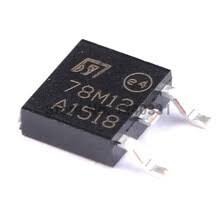
78M12ST DPAK
The L78M series of three-terminal positive regulators is available in TO-220, TO-220FP, DPAK and IPAK packages and with several fixed output voltages, making it useful in a wide range of applications. These regulators can provide local on-card regulation, eliminating the distribution problems associated with single point regulation. Each type employs internal current limiting, thermal shutdown and safe area protection, resulting it essentially indestructible. If adequate heat sinking is provided, they can deliver over 0.5 A output current. Although designed primarily as fixed voltage regulators, these devices can be used with external components to obtain adjustable voltage and currents.
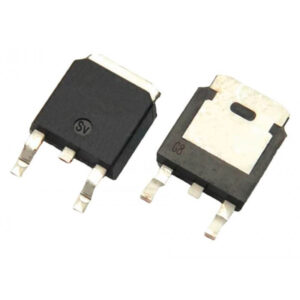
78M15ST DPAK
The L78M series of three-terminal positive regulators is available in TO-220, TO-220FP, DPAK and IPAK packages and with several fixed output voltages, making it useful in a wide range of applications. These regulators can provide local on-card regulation, eliminating the distribution problems associated with single point regulation. Each type employs internal current limiting, thermal shutdown and safe area protection, resulting it essentially indestructible. If adequate heat sinking is provided, they can deliver over 0.5 A output current. Although designed primarily as fixed voltage regulators, these devices can be used with external components to obtain adjustable voltage and currents.
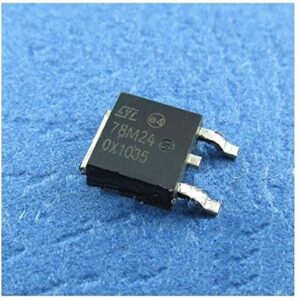
78M24ST DPAK
The L78M series of three-terminal positive regulators is available in TO-220, TO-220FP, DPAK and IPAK packages and with several fixed output voltages, making it useful in a wide range of applications. These regulators can provide local on-card regulation, eliminating the distribution problems associated with single point regulation. Each type employs internal current limiting, thermal shutdown and safe area protection, resulting it essentially indestructible. If adequate heat sinking is provided, they can deliver over 0.5 A output current. Although designed primarily as fixed voltage regulators, these devices can be used with external components to obtain adjustable voltage and currents.
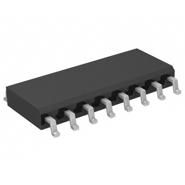
CD4021ST SOIC
The HCF4021 is a monolithic integrated circuit fabricated in metal oxide semiconductor technology available in PDIP-16 and SO-16 packages.
This device is an 8-stage parallel or serial-input/serial-output register having common clock and parallel/serial control inputs, a single serial data input, and individual parallel "jam" inputs to each register stage. Each register stage is a D-type, master-slave flip-flop in addition to an output from stage 8. "Q" outputs are also available from stages 6 and 7. Serial entry is synchronous with the clock but parallel entry is asynchronous.
In this device, entry is controlled by the parallel/serial control input. When the parallel/serial control input is low, data are serially shifted into the 8-stage register synchronously with the positive transition of the clock line. When the parallel/serial control input is high, data are jammed into the 8-stage register via the parallel input lines and synchronous with the positive transition of the clock line. The clock input of the internal stage is “forced” when asynchronous parallel entry is made. Register expansion using multiple packages is permitted.


L6562ST SOIC8
The L6562A is a current-mode PFC controller operating in Transition Mode (TM). Coming with the same pin-out as its predecessors L6561 and L6562, it offers improved performance.
The highly linear multiplier includes a special circuit, able to reduce AC input current distortion, that allows wide-range-mains operation with an extremely low THD, even over a large load range.
The output voltage is controlled by means of a voltage-mode error amplifier and an accurate (1% @TJ = 25°C) internal voltage reference.
The device features extremely low consumption (60µA max. before start-up and <5 mA operating) and includes a disable function suitable for IC remote ON/OFF, which makes it easier to comply with energy saving requirements (Blue Angel, EnergyStar, Energy2000, etc.).
An effective two-step OVP enables to safely handle overvoltages either occurring at start-up or resulting from load disconnection.
The totem-pole output stage, capable of 600 mA source and 800 mA sink current, is suitable to drive high current MOSFETs or IGBTs. This, combined with the other features and the possibility to operate with the proprietary Fixed-Off-Time control, makes the device an excellent low-cost solution for EN61000-3-2 compliant SMPS in excess of 350W.
L6565ST SOIC
The L6565 is a current-mode primary controller IC, specifically designed to build offline Quasi-resonant ZVS (Zero Voltage Switching at switch turn-on) flyback converters.
Quasi-resonant operation is achieved by means of a transformer demagnetization sensing input that triggers MOSFET's turn-on.
Converter's power capability variations with the mains voltage are compensated by line voltage feedforward. At light load the device features a special function that automatically lowers the operating frequency still maintaining the operation as close to ZVS as possible. In addition to very low start-up and quiescent currents, this feature helps keep low the consumption from the mains at light load and be Blue Angel and Energy Star compliant.
The IC includes also a disable function, an on-chip filter on current sense, an error amplifier with a precise reference voltage for primary regulation and an effective two-level overcurrent protection.